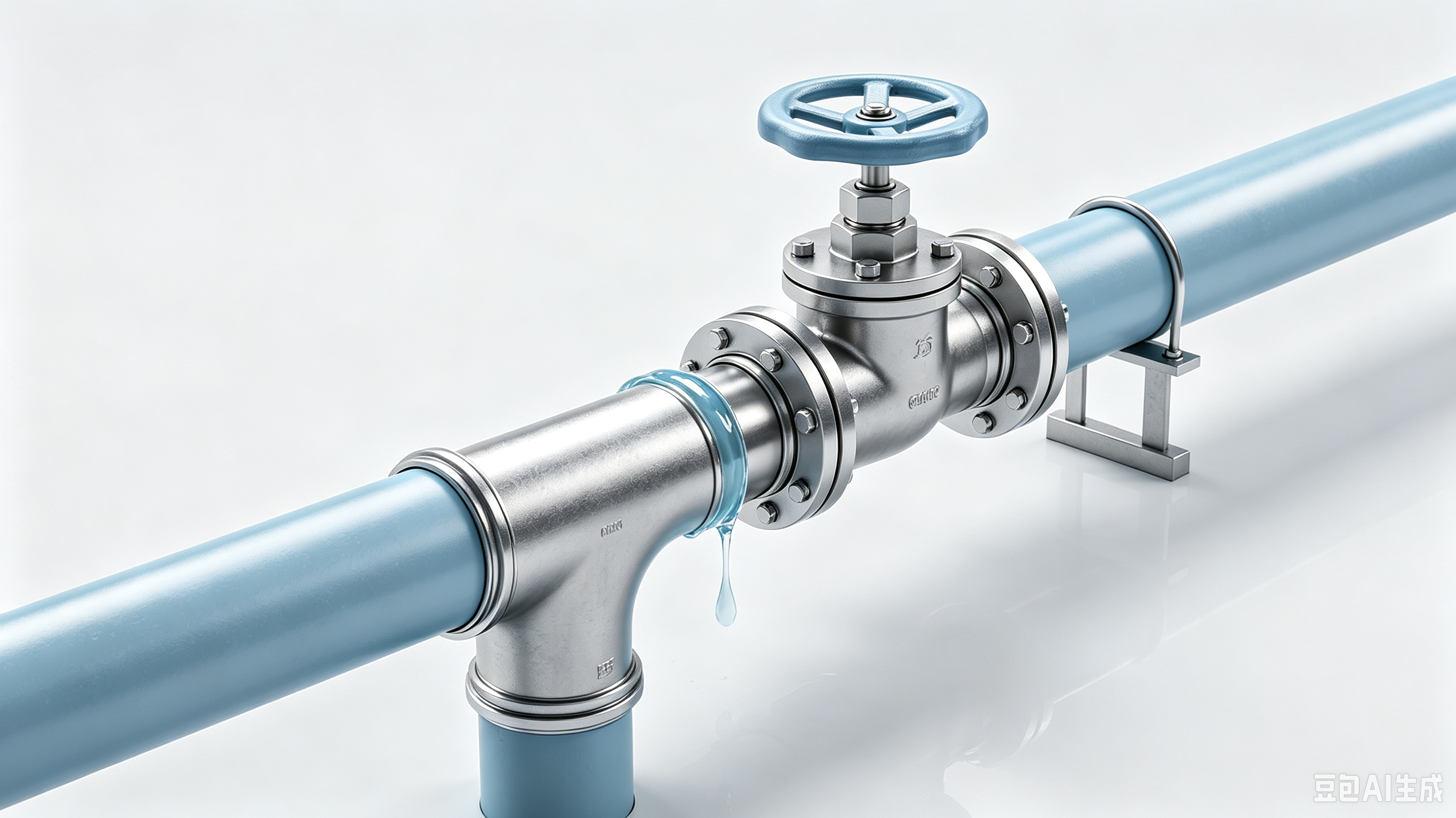
Leakage at Narrow Pipe Joints: Hidden Hazards and Wrap-Around Solutions
News 2026-08-14
The most troublesome malfunctions at industrial sites are often not obvious equipment shutdowns, but concealed pipe joint leaks hidden in valve pits, equipment interlayers and pipe galleries. Confined spaces prevent personnel access and visual inspection, and massive losses may have already occurred by the time leaks are detected.
I. Hazards Extend Far Beyond Minor Water Seepage
Pipe joints constitute the weakest links along the entire pipeline. Characterized by thin wall thickness, constant vibration exposure and concentrated stress at welds, they are prone to corrosion perforation or crack leakage. If the conveyed medium is high-temperature steam, toxic gas or flammable and explosive fluid, leakage may lead to scalds, poisoning, fires or even explosions.
Even if the medium is merely water, long-term seepage will erode building foundations, corrode surrounding equipment and waste water resources. Underground pipeline leakage may even hollow out roadbeds and threaten the safety of structures. The core risk lies not in the volume of leakage, but in undetectable leaks.
II. Invisible Leaks Pose the Greatest Detection Challenges
Detecting leaks at narrow pipe joints presents straightforward difficulties:
- Space constraints: Conventional inspection equipment cannot reach flange connections, inside valve pits or beneath machinery.
- Concealed locations: Leaks are tucked deep inside pipe galleries, above suspended ceilings or within trenches, falling outside routine inspection coverage.
- Delayed detection: By the time water stains or abnormal odors surface, leaks may have persisted for days or even weeks.
III. Wrap-Around Leak Detection Cables: Electronic Sentinels Attached to Pipes
The working principle of such detection cables is uncomplicated: two spirally wound conductive core wires are coated with water-absorbent polymers. The cables remain insulated when dry, yet their resistance plummets upon contact with liquid, triggering an immediate alarm from the control unit.
Their advantages perfectly address the aforementioned pain points:
- Wrap-around installation: High flexibility allows tight fitting around pipe joints, flanges and valves with arbitrary bending, unaffected by spatial limitations.
- Full-length monitoring: An alarm activates at any point where the cable touches liquid, eliminating the need to predict potential leak locations in advance.
- Resistance to harsh industrial environments: The outer sheath resists acids, alkalis and corrosion, while the spiral structure mitigates electromagnetic interference for deployment in severe working conditions.
- Leak localization (localizable models): The leak position is calculated via resistance variation with a positioning error of less than 0.5 meters, enabling maintenance crews to pinpoint faults immediately upon arrival.
Mature commercial products include the Like series (spiral structure, reusable) and TraceTek TT5001 (ideal for dual-seal applications on storage tanks and pipelines). Localizable or non-localizable models can be selected based on on-site requirements.
IV. Practical Deployment Recommendations
Prioritize installation at the following locations: valve pits, flange joints, under-equipment interlayers and pipe gallery bends.
- Localizable cables are recommended for long-distance pipelines or critical zones.
- Non-localizable cables suit partial key protection areas.
- Conduct regular sensitivity tests on detection cables to guarantee reliable liquid-triggered alarms.
Pipelines cannot alert operators to faults autonomously, and every undetected leak escalates into a major issue. Installing a detection cable to monitor these hard-to-see corners delivers far greater cost efficiency than emergency post-leak repairs.